
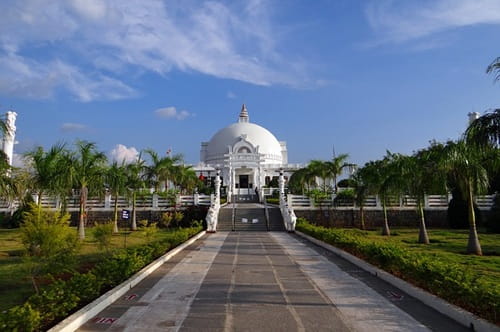
Buddha Vihar Gulbarga is one of Karnataka’s most significant Buddhist monuments and spiritual destinations — a 24-acre complex on Sedam Road, approximately 6 km from Kalaburagi city centre and adjacent to Gulbarga University, in the locality known as Kusnur (also spelled Kusnoor). PIN code 585105–585106 for the Kusnur-Sedam Road zone. The vihara sits on a small hillock rising 60 feet above ground level, built on three levels each approximately 100 feet long, with an approach path of nearly 500 feet from the main entrance flanked by gardens, flowering trees, and fruit-bearing trees throughout.
The structure was inaugurated on January 7, 2009 by then-President Pratibha Patil in the presence of His Holiness the Dalai Lama — an opening ceremony that marked not just the completion of a building but the formal recognition of Gulbarga’s deep Buddhist heritage. Construction had begun in February 2002 under the Siddhartha Vihar Trust, founded by M. Mallikarjun Kharge, with ₹10 crore each from the central and state governments. The resulting complex is one of South India’s most architecturally striking Buddhist sites, drawing visitors, students, and meditators from across the region.
| Feature | Details |
| Location | Sedam Road (near Gulbarga University), Kusnur zone, Kalaburagi |
| PIN Code | 585105 / 585106 |
| Distance from City | ~6 km from Kalaburagi district headquarters |
| Nearest Railway Station | Kalaburagi Railway Station – ~8 km |
| Nearest Airport | Kalaburagi Airport (Gulbarga Airport) – within city; Hyderabad (Rajiv Gandhi Intl) – ~235 km |
| Key Road | Sedam Road; Kusnoor Road; Ring Road Kalaburagi |
| Complex Size | 24 acres (Government of Karnataka says 18 acres; various sources cite 24 acres; complex has expanded) |
| Dome Height | 70 feet; Dome Diameter: 59 feet; Four 48-foot Ashoka pillars at corners |
| Architect Inspiration | Sarnath and Ajanta Buddhist centres |
| Inaugurated | January 7, 2009 |
| Trust | Siddhartha Vihar Trust (founded by M. Mallikarjun Kharge) |
| Adjacent Institution | Gulbarga University |
| Key Annual Event | Buddha Purnima (celebrated annually; 2026 date: May 1) |
Buddha Vihar Gulbarga Connectivity – Sedam Road, Rail, and Air
Sedam Road is the primary access corridor for Buddha Vihar — a major Kalaburagi arterial road that runs from the city centre southeastward toward Sedam town and connects en route to Gulbarga University, the Government Medical College, and the Kusnur residential zone. The drive from the city’s main Chowk area to the vihara complex takes approximately 15 to 20 minutes by auto-rickshaw or cab under normal traffic conditions.
Kalaburagi Railway Station — the city’s main junction on the Secunderabad-Wadi-Pune railway line — is approximately 8 km from the vihara. The station connects Kalaburagi to Hyderabad (approximately 4 hours), Pune, Mumbai, Bangalore, and through the Secunderabad corridor to Chennai and other major South Indian cities. The railway station is the city’s primary intercity transit hub, and most visitors arriving from outside Karnataka reach Kalaburagi by train before proceeding to the vihara by auto or cab.
Kalaburagi Airport (Gulbarga Airport, IATA code GBI) is within the city’s reach for domestic services. Hyderabad’s Rajiv Gandhi International Airport at approximately 235 km is the nearest major international airport — a 3.5 to 4 hour road journey or a 4-hour train journey. Visitors from Bangalore (approximately 622 km by road via NH-50) typically arrive by overnight train or bus.
City buses from the Kalaburagi city bus stand serve the Sedam Road corridor, with stops within accessible distance of the university-vihara zone. Auto-rickshaws, cabs, and app-based taxis (Ola, Uber are available in Kalaburagi) cover the last-mile journey comfortably. The complex itself is closed between 1 PM and 4 PM daily — an important timing note for visitors planning their approach.
Buddha Vihar Gulbarga Architecture, Landmarks, and Facilities
The vihara’s architectural language draws directly from India’s ancient Buddhist heritage. The main dome — 70 feet high and 59 feet in diameter — is tiled with white marble and crowned with an ornamental spire made of panchaloha (five-metal alloy) with a kalasha on top. Four Ashoka pillars, each 48 feet tall, stand at the four corners of the complex in honour of Emperor Ashoka the Great — the Mauryan ruler whose royal patronage spread Buddhism across the subcontinent and whose edicts were found at Sannathi in Kalaburagi district, establishing the region’s own Buddhist antiquity.
The Lord Buddha chaitya (temple, in Pali) is on the ground floor. A meditation centre in the cellar — specifically described by visitors as extremely serene and quiet — provides structured meditation space. The complex bans photography beyond the entrance arch, which enforces the contemplative atmosphere and distinguishes the experience from ordinary tourism. The garden approach — 500 feet of tree-lined path from gate to vihara — is as much a part of the experience as the dome itself.
The Siddhartha Vihar Trust maintains the complex, and it houses an International Institute of Pali, Sanskrit and Comparative Philosophy — an unusual academic addition that makes the Buddha Vihar a centre of scholarly engagement alongside its spiritual function.
Gulbarga University, immediately adjacent, is the zone’s primary institutional presence — a state university established in 1980 serving the academic population of Hyderabad-Karnataka region with undergraduate and postgraduate programmes across science, arts, commerce, and education. The university’s proximity to the vihara creates an intellectually active neighbourhood context unusual for a Buddhist sacred site.
Kusnoor Road connects the Sedam Road corridor to the broader city network. The Gulbarga Fort (a 14th-century Bahmani sultanate fort), Khwaja Banda Nawaz Dargah, and Sharana Basaveshwara Temple are the city’s other major landmarks accessible by the same Kalaburagi-wide transit network.
Schools, Colleges, and Healthcare Near Buddha Vihar Gulbarga
The Sedam Road-Kusnoor zone’s education infrastructure includes Mehta School, Chanakya School, Al-Badar B.Ed College Kalaburagi, and Global Women’s College of Education — all accessible within the broader Kusnoor-Kalaburagi zone. The Gurukul PU College near Kusnoor is within the immediate zone.
Healthcare in the Kusnoor-Sedam Road belt includes Vivekanand Hospital, Suraksha Maternity and General Hospital, and Salgar Hospital serving routine and secondary care. On Kusnoor Road itself, Dr. B.N. Joshi’s surgical practice operates near the government primary school in Sedam Road’s Tilak Nagar section. The Basaveshwara Teaching and General Hospital — an 820-bed facility affiliated with Mahadevappa Rampure Medical College (MRMC), established in 1990 on Sedam Road itself — is the zone’s most significant tertiary healthcare institution, essentially at the same address corridor as Buddha Vihar. Gulbarga Institute of Medical Sciences (GIMS), established 2013 on Sedam Road and affiliated with Rajiv Gandhi University of Health Sciences, is the government medical college for the district.
This concentration of medical education on Sedam Road — MRMC, GIMS, and associated hospitals — gives the Buddha Vihar-Gulbarga University zone an unusual institutional density for what appears externally to be a semi-peripheral city address.
Buddha Vihar Gulbarga Real Estate – The Kusnoor Zone
The Kusnoor zone on and around Sedam Road carries the character of an established residential neighbourhood serving Gulbarga University faculty, medical college staff, government employees, and Buddhist community members who wish to live near the vihara. Kusnoor’s residential stock is primarily independent houses and builder floors — Kalaburagi’s dominant residential housing type — with limited apartment society development.
Kusnoor as a locality is described in real estate assessments as a prime northeast Gulbarga location with good auto and cab accessibility, no heavy traffic, walkable daily amenities, and a safe residential character. The broad Kalaburagi real estate market is at an early urbanisation stage — prices significantly below Bengaluru or Hyderabad but growing as infrastructure investment, including the Kalaburagi-Hyderabad highway upgrade, improves intercity access.
Shopping access for Kusnoor residents runs through Asain Mohal, Asian Commercial Complex, Gold Hub, and Sharda Mall — Kalaburagi’s commercial anchors — within the zone’s accessible distance.
Buddha Vihar Gulbarga Environment – University Campus, Hillock Gardens, and Air Quality
The Buddha Vihar complex’s 24-acre grounds are consistently described as the cleanest and most peaceful spot in Gulbarga — a designation that says as much about the overall city’s environment as it does about the vihara’s maintenance standards. The hillock positioning, the tree-lined approach path, the gardens with flowering and fruit-bearing trees, and the surrounding bird population create a natural environment of genuine quality within the broader Kalaburagi landscape.
Kalaburagi’s climate is semi-arid — hot summers (April to June reaching above 40°C), a moderate southwest monsoon from June to September receiving approximately 567 mm annually (2024–25 figures), and a pleasant winter from October to February. The post-monsoon and winter season is the zone’s most comfortable period for visiting the vihara, with cooler temperatures and the greenery revival that follows the rains.
Sedam Road’s traffic between the university and the city generates noise and vehicle emissions on the road-facing boundaries but diminishes rapidly 500 metres into the vihara’s approach path. The Gulbarga Fort and surrounding historic areas maintain the city’s heritage character against the backdrop of a mid-sized Karnataka city undergoing steady infrastructure development.
5 FAQs About Buddha Vihar Gulbarga
Q1. Who inaugurated the Buddha Vihar in Gulbarga?
Buddha Vihar Kalaburagi was inaugurated on January 7, 2009 by then-President Pratibha Patil in the presence of His Holiness the Dalai Lama. The Siddhartha Vihar Trust, founded by M. Mallikarjun Kharge, led the construction, which began in February 2002. The project received ₹10 crore each from the central and state governments.
Q2. How far is Buddha Vihar from Kalaburagi city centre?
Approximately 6 km on Sedam Road near Gulbarga University. The journey takes 15 to 20 minutes by auto-rickshaw or cab. The complex is closed between 1 PM and 4 PM daily — visitors should plan arrival before noon or after 4 PM.
Q3. What is architecturally unique about Buddha Vihar Gulbarga?
The main dome is 70 feet high and 59 feet in diameter, marble-tiled, and crowned with a panchaloha spire. Four 48-foot Ashoka pillars stand at the four corners. The design draws from Sarnath and Ajanta. A cellar meditation hall, a ground-floor chaitya, and a 500-foot garden approach are the experiential layers. Photography is restricted beyond the entrance arch.
Q4. What institutions are adjacent to Buddha Vihar?
Gulbarga University is immediately adjacent. Mahadevappa Rampure Medical College and its associated 820-bed Basaveshwara Teaching and General Hospital are on the same Sedam Road corridor. Gulbarga Institute of Medical Sciences (GIMS) is also on Sedam Road — making this one of the more institutionally concentrated stretches of any city in Hyderabad-Karnataka.
Q5. How does Gulbarga’s Buddhist heritage connect to the vihara?
Sannathi village in Kalaburagi district was a major Mauryan-era Buddhist centre comparable in stature to Amaravati and Sanchi — established by historical findings of Buddhist stupas, edicts of Emperor Ashoka, and archaeological evidence of sustained Buddhist learning during the Mauryan period. The Buddha Vihar acknowledges and revives this heritage, connecting contemporary Karnataka to its pre-medieval Buddhist identity.