
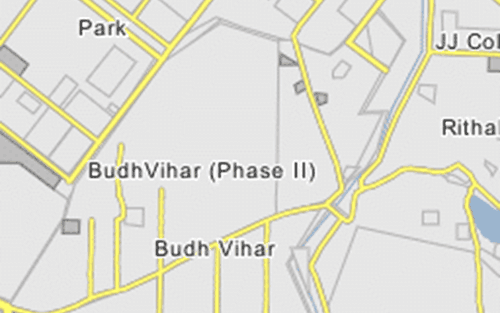
Budh Vihar Delhi is a high-density residential locality in Northwest Delhi, sitting at the boundary where Rohini’s planned sector grid meets the Western Yamuna Canal’s agricultural edge — a position that gives it the Red Line metro at Rithala within 2.4 km, Rohini’s established market and school infrastructure within easy access, and the Western Yamuna Canal’s open green boundary as an unusual natural feature for a Delhi residential zone. PIN code 110086. The locality spans two phases — Budh Vihar Phase I and Phase II — both within the same PIN, both served by the same metro and road network.
Despite being described as “not particularly posh,” Budh Vihar has consistently attracted attention from analysts for its development potential — a zone with structurally good connectivity, established social infrastructure, and property prices that remain accessible relative to adjacent Rohini sector zones where similarly positioned addresses command ₹10,000 to ₹11,000 per sq ft premiums.
| Feature | Details |
| Location | Northwest Delhi (Rohini-Rithala zone) |
| PIN Code | 110086 |
| Nearest Metro | Rithala – Red Line (~2.4 km) |
| Additional Metro | Rohini West – Red Line (~3 km) |
| Railway Stations | Mangolpuri Railway Station (~5.4 km); Nangloi Railway Station |
| Key Roads | Kanjhawala Road; Main Rithala Road; Outer Ring Road; CH Gugan Singh Marg |
| Canal Boundary | Western Yamuna Canal (northern edge) |
| Airport Distance | IGI Airport – approx. 24 km |
| Avg. Property Rate | ₹10,538 per sq ft (April 2026) |
| Monthly Rental Range | Active mid-segment rental market |
| Key Institutions | Keshav Mahavidyalaya (Delhi University); CBSE Patrachar Vidyalaya |
| Key Hospitals | Brahm Shakti Hospital; Nulife Multi-Specialty Hospital; Sanjay Gandhi Memorial Hospital Mangolpuri |
| Key Green Spaces | Japanese Park (~5 km); Budh Vihar Temple Complex |
| Resident Rating | 4.1/5 connectivity (Phase 2); strong RWA governance |
Budh Vihar Delhi Connectivity – Red Line Metro, Kanjhawala Road, and Canal Zone
Rithala metro station on the Red Line is approximately 2.4 km from Budh Vihar Phase I, making it the locality’s primary daily metro gateway. Rithala is the Red Line’s western terminal — every train from here travels eastward through Rohini West, Rohini East, Pitampura, Netaji Subhash Place, Inderlok, Kashmere Gate, and New Delhi Railway Station, and then continues to Dilshad Garden and Shaheed Sthal. The full Red Line corridor is accessible from Budh Vihar without any interchange, covering the North Delhi employment spine in a single unbroken route.
Rohini West metro station provides a second Red Line option at approximately 3 km — useful for residents in Budh Vihar’s Rohini-facing eastern blocks. The two stations together create a dual-approach metro access that gives Budh Vihar’s different sub-localities flexible choices based on walking direction.
Kanjhawala Road is the locality’s primary road connector, linking northward toward Kanjhawala, Pooth Kalan, and Haryana, and southward toward the Rohini sector road network and Outer Ring Road. Main Rithala Road connects directly toward Rithala and the metro station. CH Gugan Singh Marg runs through the locality’s internal blocks, connecting its residential pockets to the main road network. The Western Yamuna Canal runs along Budh Vihar’s northern edge — a natural boundary that has historically limited northward development and preserved the zone’s semi-open character.
Mangolpuri Railway Station at approximately 5.4 km and Nangloi Railway Station provide suburban rail for intercity travel and Ring Railway access. Outer Ring Road is accessible from the zone’s southern boundary for road-based commuting toward Pitampura, Rohini’s outer belt, and the Delhi-Haryana highway network.
Budh Vihar Delhi Landmarks and Key Facilities
The Budh Vihar Temple Complex is the locality’s namesake and defining cultural landmark. The temple — associated with Buddhist ceremonies and particularly active during Vesak (Buddha Purnima) — hosts meditation sessions, dharmic workshops, and the annual lantern show that draws the Buddhist and broader spiritual community from across Northwest Delhi. The festival-period events at Budh Vihar Temple are among the more culturally distinctive observances in Northwest Delhi’s residential belt.
Japanese Park, approximately 5 km from Budh Vihar, is the zone’s primary large-scale recreational green space — the 76-acre themed urban park with manicured Japanese garden design, koi features, and walking trails that serves the broader Rohini-Pitampura belt. Residents make regular weekend trips for the park’s quality of greenery and managed environment.
Budh Vihar Market handles daily grocery, vegetable, pharmacy, and household service needs within the locality itself. The broader Rohini sector markets and City Centre Rohini are within accessible range for branded retail and entertainment. M2K Cinemas complex provides multiplex entertainment within the broader zone, described as a popular family entertainment destination by Budh Vihar residents.
Keshav Mahavidyalaya — a Delhi University college primarily serving B.Sc. and B.Com programmes — operates in the zone adjacent to Budh Vihar and generates consistent student rental demand for the locality’s 1 BHK and shared housing segments. CBSE Patrachar Vidyalaya serves students seeking alternative board examination pathways, adding a second educational institution for the zone’s student population.
Schools, Colleges, and Healthcare in Budh Vihar
Prince Public School and MCD schools within Budh Vihar serve the locality’s K–12 primary education population. Delhi Public School Rohini, Ryan International School, and DAV Public School are accessible within the broader Rohini sector zone for families willing to commute slightly further for premium private school options.
Brahm Shakti Hospital at U-1/76 Budh Vihar is the most directly cited hospital in the locality — a secondary care facility that handles routine medicine, surgery, and emergency cases for the Budh Vihar population. MCW Budh Vihar Phase I — the Maternity and Child Welfare Centre — provides government maternal and child health services for the locality’s families. Nulife Multi-Specialty Hospital is an additional secondary care option. Sanjay Gandhi Memorial Hospital in Mangolpuri, a government hospital accessible from the broader zone, provides government-subsidised emergency and inpatient care. Asha Kiran Mental Hospital in the broader Rohini zone and Kanta Sethi Hospital in Rithala extend the healthcare network.
Budh Vihar Delhi Real Estate – Property Rates and Market
Budh Vihar’s average apartment rate stands at ₹10,538 per sq ft as of April 2026 — a figure that sits above the Mangolpuri-Krishan Vihar affordable segment (₹4,000–₹7,000) and below the Rohini sector average of ₹10,400–₹10,900, placing Budh Vihar precisely at the threshold where affordability and Rohini-adjacent quality overlap.
The housing stock spans independent houses and builder floors across both phases. Budh Vihar Phase I has tighter internal lanes but an established community character; Phase II has somewhat wider road access and is described as more organised. Rental demand is strong due to affordable prices relative to adjacent Rohini sectors — exactly the price advantage that keeps Budh Vihar’s rental market consistently occupied even when broader real estate activity softens.
Keshav Mahavidyalaya’s student population generates consistent demand for affordable shared housing and 1 BHK configurations. Industrial workers from Mangolpuri Industrial Area and logistics-sector employees from the broader Northwest Delhi industrial belt form the second rental demand segment.
Budh Vihar Delhi Environment – Western Yamuna Canal, Buddhist Temple, and Air Quality
The Western Yamuna Canal along Budh Vihar’s northern edge creates a semi-natural boundary that has both environmental and spatial benefits. The canal corridor — with its water channel, embankment vegetation, and restricted development zone on the opposite side — gives Budh Vihar’s northward-facing properties an open horizon and a modest air movement benefit compared to landlocked Northwest Delhi localities with dense construction on all sides.
The Budh Vihar Temple Complex’s maintained garden and open compound adds a second green feature within the locality itself. Japanese Park at 5 km extends the green recreation access for families willing to travel for a quality outdoor experience.
Residents consistently describe the locality as safe with active RWAs, well-lit streets, and regular police patrolling — reflected in the community governance assessments that note security guard presence in residential complexes and strong community network contribution to safety. Budh Vihar Phase 2 residents rate connectivity at 4.1 out of 5 — a respectable score for a Northwest Delhi address at this price point.
Air quality tracks the Northwest Delhi seasonal pattern: the Western Yamuna Canal’s open character provides marginal air quality benefit over completely landlocked zones, but the Mangolpuri Industrial Area at approximately 5 to 6 km and Outer Ring Road’s vehicle traffic remain the primary pollution drivers. Drainage in lower-lying blocks remains a recurring monsoon challenge — a civic infrastructure gap that RWAs have flagged without full municipal resolution.
5 FAQs About Budh Vihar Delhi
Q1. Which metro station serves Budh Vihar?
Rithala on the Red Line is approximately 2.4 km away — the primary metro access. Rohini West is approximately 3 km in the opposite direction for Phase II residents. Rithala is the Red Line’s western terminal, with every train running eastward through Rohini, Pitampura, Netaji Subhash Place, and New Delhi Railway Station in a single unbroken route.
Q2. What is the Budh Vihar Temple Complex?
The Budh Vihar Temple Complex is a Buddhist temple in the locality that hosts meditation workshops, dharmic events, and the Vesak (Buddha Purnima) celebrations with lantern shows. It is the locality’s namesake and the primary cultural landmark that gives the neighbourhood its distinct character within Northwest Delhi’s residential belt.
Q3. What are property rates in Budh Vihar?
Average apartment prices are ₹10,538 per sq ft as of April 2026 — just above the Rohini sector floor and below the Rohini sector premium average, placing Budh Vihar at the affordability-quality crossover point in Northwest Delhi’s residential market. Rental demand is strong from Keshav Mahavidyalaya students and Mangolpuri industrial workers.
Q4. Which college is in Budh Vihar?
Keshav Mahavidyalaya, a Delhi University college, operates adjacent to Budh Vihar and offers B.Sc. and B.Com programmes. CBSE Patrachar Vidyalaya provides alternative board examination access. Together they create consistent student rental demand for the locality.
Q5. How is the safety in Budh Vihar?
Residents describe the locality as safe with active Resident Welfare Associations, well-lit streets, security guards in residential complexes, and regular police patrolling. Budh Vihar Phase 2 has a connectivity rating of 4.1 out of 5 in resident assessments. The strong community network is consistently cited as contributing to the neighbourhood’s security quality.