
Mayur Vihar Phase 1 Delhi is the original residential phase of the Mayur Vihar belt — and four decades after its development, it remains the most densely serviced and best-connected of all three phases. PIN code 110091, East Delhi. It sits closest to the Yamuna River on its eastern boundary, nearest to Akshardham on its north-western approach, and is served directly by two metro lines at a single interchange station. Phase 1 is where cooperative housing societies, older DDA flats, and a steadily growing inventory of rebuilt builder floors coexist in a neighbourhood that works harder than its density suggests it should.
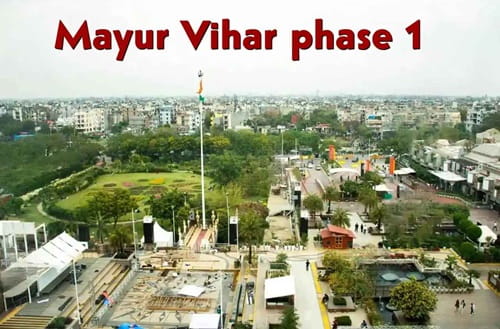
Mayur Vihar Phase 1 Delhi Quick Overview
| Feature | Details |
| Location | East Delhi |
| PIN Code | 110091 |
| Metro Station | Mayur Vihar I – Blue Line + Pink Line Interchange |
| Additional Metro | Mayur Vihar Pocket 1 – Pink Line (northern pockets) |
| Key Roads | National Expressway 3, Patparganj Road |
| Nearest Railway Station | Mandawali-Chandra Vihar – approx. 5 km; Anand Vihar Terminal – approx. 7 km |
| Airport Distance | IGI Airport – approx. 22 km via NH-48 |
| Avg. Apartment Rate | ₹14,689 per sq ft (approx.) |
| Key Landmark | Ahlcon Public School, Jeevan Anmol Hospital, Acharya Niketan Market |
| Prominent Green Space | Sanjay Lake, DDA parks across sectors |
Mayur Vihar Phase 1 Connectivity – Metro, Roads, and Rail
Mayur Vihar Phase 1 has a genuine transit advantage that its residents are well aware of and that prospective buyers routinely cite as the primary reason for choosing the locality over comparable East Delhi addresses. Mayur Vihar I metro station — the Blue Line and Pink Line interchange — is embedded into the Phase 1 fabric. The Blue Line takes residents directly to Laxmi Nagar, Indraprastha, Connaught Place, and Noida’s IT belt with no change required. The Pink Line connects toward Anand Vihar, Karkardooma, and the ring corridor north toward Majlis Park and south toward Lajpat Nagar.
Mayur Vihar Pocket 1 on the Pink Line serves the northern pockets of Phase 1, which otherwise fall slightly outside comfortable walking distance of the main interchange. Together these two stations mean that the great majority of Phase 1’s residential blocks have a metro entry point within 10 to 15 minutes on foot or a short e-rickshaw ride. E-rickshaws operating the internal feeder routes charge ₹10 per person and run frequently — a functioning last-mile system that makes the metro practical for residents who do not live directly adjacent to either station.
National Expressway 3 gives Phase 1 direct access to Noida and the Delhi-UP border by road. Patparganj Road connects toward Patparganj Industrial Area and onward to IP Extension. Anand Vihar Terminal, approximately 7 km away, provides intercity rail connections. For airport travel, the 22 km via NH-48 takes approximately 40 to 50 minutes by car under normal conditions.
Mayur Vihar Phase 1 Landmarks and Key Facilities
Ahlcon Public School defines the educational character of Mayur Vihar Phase 1 more than any other single institution. Established in 1988 by the Shanti Devi Progressive Education Society, this CBSE-affiliated co-educational school operates from a 3.5-acre campus with an enrollment of over 3,200 students, running classes from Kindergarten through Class 12. Its presence within the phase — rather than on a major road outside it — is one of the reasons families specifically seek Phase 1 over other Mayur Vihar phases. Ahlcon International School adds a second quality institution to the immediate catchment.
Acharya Niketan Market is Phase 1’s commercial anchor — a functional DDA market that handles groceries, clothing, banking, restaurants, and daily services in a compact and well-used strip. Ganga Market and Pankaj Tower are additional commercial nodes serving different pockets of the phase.
Holiday Inn Mayur Vihar-Noida at the District Centre is the locality’s most prominent hospitality landmark, serving both corporate travellers and families visiting the Akshardham complex nearby. The Swaminarayan Akshardham Temple — one of the world’s largest Hindu temple complexes — is reachable from Phase 1 in a short drive or via the adjacent Akshardham metro station, making it both a daily visual presence and a practical cultural destination for residents.
Schools, Colleges, and Healthcare in Mayur Vihar Phase 1
Beyond Ahlcon, Phase 1 carries a strong school ecosystem. ASN International School, Aster Public School, Shemrock Blossoms, Evergreen Public School, and Rishabh Public School collectively ensure that families at different budget levels have quality primary and secondary education options without leaving the immediate neighbourhood. Coaching institutes for competitive exams are active along the main market strips, taking advantage of the metro connectivity that lets students travel to Laxmi Nagar’s larger coaching hub without making Phase 1 their base.
Healthcare within Phase 1 is anchored by Jeevan Anmol Hospital near the metro station — a multi-specialty private facility offering 24-hour emergency services. Kukreja Hospital serves routine and secondary care for a large resident base. Bapu Nature Cure Hospital and Yogashram provides alternative medicine and wellness services. Central Government Health Scheme dispensaries serve eligible government employees within the cooperative society residents, a demographic that forms a significant portion of Phase 1’s older housing stock.
For critical care, Max Super Speciality Hospital in Vaishali and Dharamshila Narayana Superspeciality Hospital are accessible via the Blue Line or road within 30 minutes.
Mayur Vihar Phase 1 Real Estate – Property Rates and Market Character
Mayur Vihar Phase 1’s property market has a specific character that sets it apart from Phase 2 and Phase 3. The housing stock here is dominated by cooperative society apartments — built in the 1980s and 1990s, often well-maintained because the cooperative governance model incentivises collective upkeep. These buildings typically have larger floor plans than comparable DDA constructions of the same era, which translates to better liveability ratios even in older stock.
The average apartment price in Phase 1 sits around ₹14,689 per sq ft. The broader Mayur Vihar Phase 1 Extension average is approximately ₹17,850 per sq ft with a 14.1% year-on-year appreciation, indicating that better-serviced pockets are pricing upward meaningfully. Monthly rentals in Phase 1 start around ₹18,000 for 1 BHK units and reach ₹40,000-plus for larger configurations in well-located buildings.
Demand drivers are consistent and multiple: Ahlcon school proximity for families, Blue Line access for Noida IT workers, and the general quality of social infrastructure that the phase has accumulated over its four-decade existence. The absence of large new supply entering Phase 1 — the area is built out — acts as a structural floor for property values.
The known caveats: parking availability is tight across most pockets, potholes on internal roads recur despite periodic repair, and water supply in parts of Phase 1 has drawn resident complaints regarding quality. These are manageable rather than disqualifying for most buyers.
Mayur Vihar Phase 1 Environment – Parks, Yamuna Proximity, and Green Character
Phase 1’s eastern edge touches the Yamuna floodplain zone — a boundary that limits construction pressure from that direction and contributes to the open eastern horizon that gives the locality a spatial breathing room unusual in dense East Delhi. While the Yamuna itself is not accessible for recreation in this stretch, the buffer created by the floodplain zone matters for environmental quality.
Sanjay Lake, within easy reach of Phase 1, is one of Delhi’s more genuinely active urban lakes. Boating, walking tracks, evening lights, and a consistent community of morning exercisers make it a meaningful green amenity rather than an underused park with a nice name. DDA-maintained parks across Phase 1’s sectors are among the better-kept in East Delhi, benefiting from the cooperative society governance model that extends some resident discipline to shared outdoor spaces.
The phase’s mature tree cover — accumulated over forty years — gives interior lanes a green quality that newer East Delhi developments cannot replicate quickly. Evenings in the residential interior of Phase 1 carry a different atmosphere from the main road noise: quieter, better shaded, and more neighbourhood-like than the arterial character of Patparganj Road would suggest.
FAQs About Mayur Vihar Phase 1 Delhi
Q1. What is the metro connectivity at Mayur Vihar Phase 1?
A: Mayur Vihar I station is an interchange for the Blue Line and the Pink Line, making Phase 1 one of the best-connected localities in East Delhi. Mayur Vihar Pocket 1 on the Pink Line serves northern pockets. E-rickshaws provide reliable feeder connectivity within the phase.
Q2. What is the average property rate in Mayur Vihar Phase 1?
A: The average apartment price is approximately ₹14,689 per sq ft. Phase 1 Extension pockets average around ₹17,850 per sq ft with approximately 14.1% year-on-year appreciation. Monthly rentals range from ₹18,000 to ₹40,000-plus depending on size and building quality.
Q3. Which school makes Mayur Vihar Phase 1 popular for families?
A: Ahlcon Public School — established in 1988, CBSE-affiliated, with over 3,200 students — is the primary school driving family demand for Phase 1. Ahlcon International School, ASN International School, and Aster Public School are additional quality options within the same zone.
Q4. How far is Akshardham temple from Mayur Vihar Phase 1?
A: Akshardham is accessible from Phase 1 in approximately 5 to 10 minutes by car or via the Akshardham metro station on the Blue Line (one stop from Mayur Vihar I). It is the nearest world-class cultural and religious landmark to any East Delhi residential area.
Q5. What type of housing is available in Mayur Vihar Phase 1?
A: Phase 1 is dominated by cooperative housing society apartments — built between the 1980s and 1990s with larger-than-average floor plans. Standalone builder floors and a smaller number of DDA flat configurations round out the housing stock. Most available inventory involves existing resale transactions rather than new launches, as the phase is largely built out.