
Sarita Vihar New Delhi stands apart from most planned colonies in the capital for a reason that rarely gets enough attention — this neighbourhood was built with a different purpose in mind, then shaped further by its own residents over four decades. Originally earmarked as the Games Village for the 1982 Asian Games, the plan changed on the insistence of late Prime Minister Rajiv Gandhi, redirecting the site toward upscale residential development instead. That origin explains the wide internal roads, the pocket-wise layout, and the parks that actually get maintained. Most Delhi localities grow organically and show it. Sarita Vihar was drawn on paper first.
Today it sits in South East Delhi as one of the more liveable DDA-planned colonies in the city, with a PIN code of 110076. Its boundaries touch Madanpur Khadar Village, Pocket A Sarita Vihar, and Tekhand, and the Yamuna River runs close enough to give the eastern edge a quality of air that purely landlocked urban neighbourhoods simply don’t get.
Quick Overview
|
Feature |
Details |
|
Location |
South East Delhi, Shahdara District |
|
PIN Code |
110076 |
|
Metro Station |
Sarita Vihar – Violet Line (approx. 700 m) |
|
Nearest Railway Station |
Hazrat Nizamuddin – approx. 8.5 km |
|
Airport Distance |
IGI Airport – approx. 22 km |
|
Key Landmark |
Indraprastha Apollo Hospital |
|
Major Road |
Mathura Road (NH 44 corridor) |
|
Avg. Apartment Rate |
Approx. ₹17,200 per sq ft |
|
Nearest Employment Hub |
Jasola District Centre, NDRAVG Business Park |
|
Green Distinction |
“Greenest Colony in Delhi” – 2013 |
Sarita Vihar Connectivity – Metro, Roads, and Rail
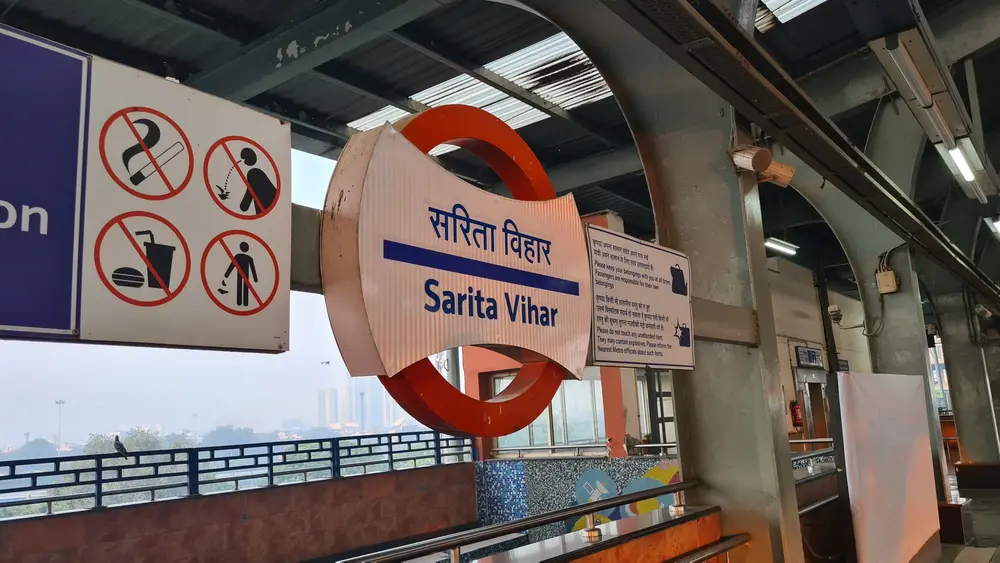
The Sarita Vihar metro station on the Violet Line is the primary transit anchor for the locality, sitting roughly 700 metres from the residential core — close enough for most residents to walk without flagging an auto. The station operates between Jasola Apollo and Mohan Estate, and the Violet Line runs the full stretch from Kashmere Gate in north Delhi down to Raja Nahar Singh in Ballabhgarh, Faridabad. That single line covers Moolchand, Lajpat Nagar, Kalkaji Mandir, and Escorts Mujesar without any interchange — a genuinely useful corridor for daily office commuters heading either toward central Delhi or deeper into Faridabad.
For those needing to cross lines, Moolchand and Central Secretariat both offer practical interchange options without excessive travel time. The Jasola Apollo metro station, just one stop away, adds a second access point that residents near the hospital end of the colony use regularly.
Road connectivity is equally solid. Mathura Road — part of the NH 44 corridor — runs along the locality’s edge and connects directly to Noida via the Kalindi Kunj–Noida Toll Bridge. Heading north, the same road feeds into central Delhi through Ashram Chowk. Hazrat Nizamuddin Railway Station is approximately 8.5 km away, and IGI Airport sits around 22 km out — manageable by metro with one change, or by cab in under 45 minutes outside peak hours. DTC bus routes including 478, 517, and 604 serve the locality, covering connections to Badarpur Border, Okhla, and nearby residential pockets.
Sarita Vihar Landmarks and Key Facilities
The single most prominent landmark anchoring Sarita Vihar’s identity is Indraprastha Apollo Hospital. It draws patients from across Delhi-NCR, runs 24-hour emergency services, and functions as the area’s most visible reference point. Its presence drives sustained rental demand in surrounding pockets — medical professionals, patient attendants, and hospital staff all need accommodation nearby, and Sarita Vihar’s residential pockets absorb much of that demand quietly and consistently.
Jasola District Centre sits immediately adjacent and brings a corporate weight to the locality that most South Delhi residential areas lack. Designed to house corporate headquarters, IT firms, and multinational companies, this commercial belt has direct metro access via Jasola Apollo station and sits right off Mathura Road. Professionals working in this zone — and in NDRAVG Business Park nearby — routinely choose Sarita Vihar for residential convenience.
Pacific Mall Jasola dominates the shopping landscape for the locality. It handles everything from branded retail to multiplex entertainment within a short drive. For more varied options, Lajpat Nagar Central Market, DLF Mall of India in Noida, and New Friends Colony market are all within practical reach.
The Lotus Temple at Kalkaji — one of Delhi’s most visited architectural sites — falls within a short drive. While it draws tourists rather than daily visitors, its proximity gives the locality a cultural landmark that most East and South Delhi colonies can’t claim in their immediate neighbourhood.
Schools, Colleges, and Healthcare in Sarita Vihar
Families are drawn to Sarita Vihar partly because of what it has on the education front. GD Goenka Public School, established in the locality in 2015, is a CBSE-affiliated co-educational institution with labs, a library, computer facilities, and sports infrastructure on a purpose-designed campus. St. Giri Public School and DAV Public School serve different age groups and academic preferences across the same neighbourhood. Acharya Narendra Dev College, a well-regarded Delhi University institution, handles higher education needs without residents needing to travel far.
On the healthcare side, Indraprastha Apollo Hospital is the heavyweight — but the locality is also served by Triton Hospital, Sanjeevani Hospital, and City Hospital for routine and secondary care needs. Fortis Escorts Heart Institute and Holy Family Hospital both fall within a 5 km radius for specialised requirements. All India Institute of Ayurveda also sits in the wider vicinity for those seeking alternative medicine consultations.
Sarita Vihar Real Estate – Property Rates and Investment Outlook
Sarita Vihar’s property market has moved sharply upward. Apartments here have seen a price appreciation of approximately 38.2% over the past year, with the current average apartment rate standing around ₹17,200 per sq ft. DDA Flats Sarita Vihar and Sarita Vihar Pocket B RWA are among the top-yielding rental projects in the locality, offering consistent occupancy driven by hospital proximity, metro access, and office belt spillover from Jasola.
The buyer profile here has shifted. Where earlier it was largely government employees and DDA allottees, today a significant share of transactions involve professionals working in the Noida–Jasola belt who want South Delhi residential quality without paying Saket or Greater Kailash prices. That shift is visible in the renovation activity across the older DDA pockets — independent floors being rebuilt, ground-floor units converted to commercial usage along the main approach roads.
One honest caveat: traffic congestion along the Mathura Road–Noida route during peak hours is a real friction point, especially around the Kalindi Kunj intersection. Parking availability inside the colony is tighter than it used to be as car ownership has grown faster than parking infrastructure. These are known trade-offs that residents factor in but rarely find dealbreaking given what the location offers in return.
Sarita Vihar Environment – Delhi’s Greenest Colony Tag
This is where Sarita Vihar genuinely earns its distinction. In 2013, the then Chief Minister of Delhi Sheila Dikshit awarded it the “Greenest Colony in Delhi” title, a recognition credited entirely to the sustained work of its Resident Welfare Association members who systematically improved parks, planted trees, and maintained green pockets across the colony. That effort hasn’t stopped — the parks across various Pockets remain noticeably cleaner and better maintained than comparable colonies of the same era and DDA origin.
The Yamuna proximity, while not a formal park or green buffer, contributes to the micro-environment in ways that longtime residents notice. Compared to the dust and particulate levels of Okhla industrial belt or Badarpur further south, Sarita Vihar’s internal air quality — particularly inside the colony, away from Mathura Road — holds up better. It’s not pollution-free by any measure, but the tree cover and resident-maintained green patches make a genuine difference to daily livability.
FAQs About Sarita Vihar New Delhi
1. Which metro line serves Sarita Vihar and where does it go?
Sarita Vihar metro station is on the Violet Line. It connects Kashmere Gate in north Delhi to Raja Nahar Singh in Ballabhgarh, Faridabad, passing through Lajpat Nagar, Kalkaji Mandir, and Escorts Mujesar en route.
2. How far is Apollo Hospital from Sarita Vihar residential area?
Indraprastha Apollo Hospital is within the immediate locality — roughly 1 km from Pocket A Sarita Vihar. It’s the most accessible major hospital from the colony and a key reason medical professionals prefer renting here.
3. What is the current property rate in Sarita Vihar?
The average apartment rate is around ₹17,200 per sq ft, with DDA flats showing strong year-on-year appreciation. Rental demand stays high due to the hospital and Jasola District Centre proximity.
4. Why is Sarita Vihar called Delhi’s greenest colony?
The “Greenest Colony in Delhi” title was awarded in 2013 by then Chief Minister Sheila Dikshit, recognising the RWA’s consistent work in maintaining parks, green belts, and tree cover across the colony’s pockets — an effort that continues today.
5. Is Sarita Vihar well connected to Noida?
Yes. The Kalindi Kunj–Noida Toll Bridge connects Sarita Vihar directly to Noida via Mathura Road, making it roughly a 10-minute drive to Noida’s border areas. Metro connectivity via the Violet Line also provides an interchange route for Noida-bound commuters.
 Saurav Mehra