
Anand Vihar New Delhi occupies a category of its own in the city’s residential geography — the only neighbourhood in Delhi that places its residents within direct walking distance of the Blue Line and Pink Line metro interchange, the Namo Bharat RRTS underground station, a full railway terminal, and a major inter-state bus terminus, all inside a single square kilometre. PIN code 110092. East Delhi address, pan-India reach. That is the Anand Vihar proposition in one sentence.
The locality sits at the intersection of Chaudhary Charan Singh Marg, Vikas Marg, and NH-24 — three of East Delhi’s principal arterial roads — and shares its name with what is genuinely one of India’s most significant multi-modal transit complexes. The residential colony wraps around this infrastructure, divided into blocks A through D and extending into sub-localities like Savita Vihar, Surya Niketan, and the AGCR Enclave pocket. Life here carries the energy of a transit hub — never entirely quiet, always moving.
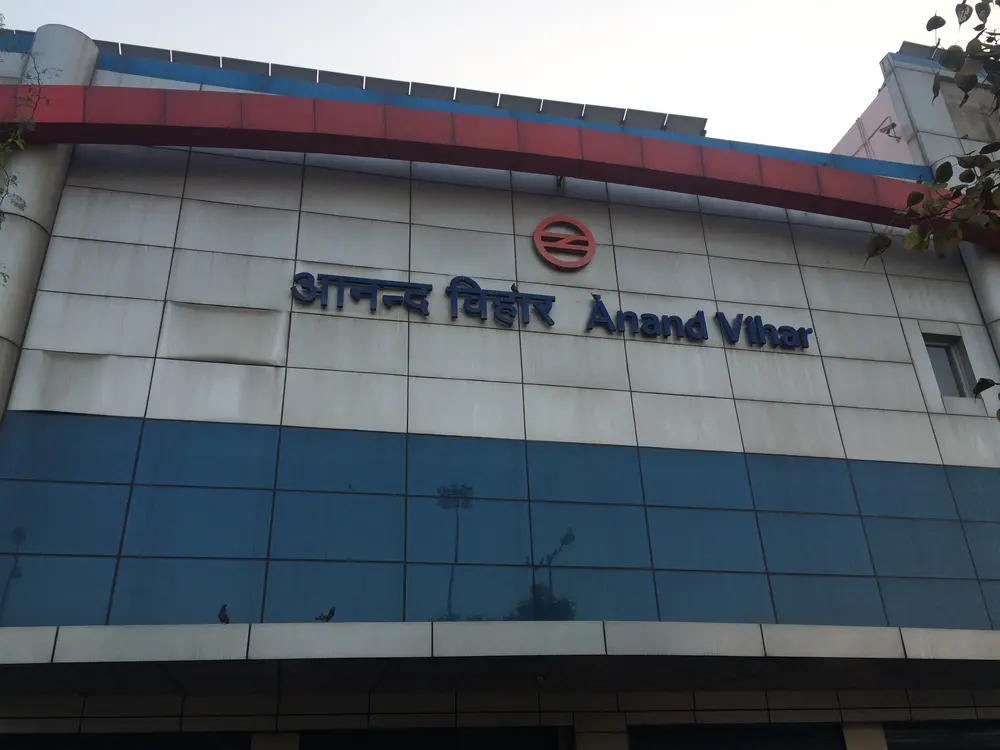
Quick Overview
|
Feature |
Details |
|
Location |
East Delhi, PIN 110092 |
|
Metro |
Anand Vihar – Blue Line + Pink Line interchange (opened Jan 2010/Oct 2018) |
|
Namo Bharat RRTS |
Anand Vihar RRTS Station – underground, operational since January 5, 2025 |
|
Railway Terminal |
ANVT (Anand Vihar Terminal) – 7 platforms, 83 originating + 83 terminating trains |
|
Bus Terminal |
Anand Vihar ISBT – inter-state buses to UP, Uttarakhand, Bihar, Haryana |
|
Key Roads |
Chaudhary Charan Singh Marg; Vikas Marg; NH-24 / Delhi-Meerut Expressway |
|
Avg. Apartment Rate |
₹14,957–₹23,810 per sq ft (NoBroker 2026); ₹16,250 per sq ft (99acres avg) |
|
Monthly Rental Range |
₹10,000–₹80,000 (1–3 BHK) |
|
Key Hospitals |
Kailash Deepak Hospital; Surya Hospital; IG ESI Hospital |
|
Key Tourist Landmark |
Swaminarayan Akshardham Temple (immediate proximity) |
|
Airport Distance |
IGI Airport – approx. 25 km |
Anand Vihar Connectivity – The Most Transit-Dense Address in East Delhi
The transit stack at Anand Vihar has no parallel in East Delhi and few equivalents anywhere in Delhi-NCR.
The metro at Anand Vihar is a Blue Line and Pink Line interchange. The Blue Line, opened here in January 2010, runs westward through Laxmi Nagar, Nirman Vihar, Preet Vihar, Karkardooma, and onward to Kashmere Gate, New Delhi, and the full western corridor toward Dwarka Sector 21. Eastward it extends to Vaishali and Kaushambi in Ghaziabad. The Pink Line interchange, added in October 2018, brought the ring corridor — connecting toward Trilokpuri Sanjay Lake, IP Extension, Lajpat Nagar, and now the completed ring through Mayur Vihar, Shiv Vihar, and the March 2026 extension that made it India’s first fully operational ring metro. Daily ridership at this interchange stood at 73,361 in October 2023 — a number reflecting commuter density from a single station.
The Anand Vihar RRTS station is underground, connected directly to the metro interchange, and opened January 5, 2025 as part of the Delhi-Meerut Namo Bharat corridor. From here, Sarai Kale Khan is reachable in under 10 minutes; Meerut in under 45 minutes. The Delhi-Meerut corridor redefined commuter geography for the entire eastern NCR belt, and Anand Vihar sits at its Delhi hub.
Anand Vihar Terminal (ANVT), the railway station, was opened in December 2009 and underwent a ₹224.48 crore airport-style upgrade in 2025-26. It now has 7 platforms handling 83 originating and 83 terminating trains — exclusively long-distance services to Uttar Pradesh, Bihar, Jharkhand, West Bengal, and eastern India, with no halting trains. Trains to Gorakhpur, Lucknow, Patna, Darbhanga, Varanasi, Howrah, and Prayagraj all originate here. The station features a heritage gallery, six lifts, two escalators, high-speed Wi-Fi, custom subways for differently-abled passengers, and a five-star rated food plaza — an unusual infrastructure quality for a terminal that primarily serves budget and unreserved class passengers from Purvanchal and Bihar.
The Anand Vihar ISBT handles inter-state buses primarily to Uttarakhand, UP, and Haryana. The terminal was due for upgrade to a full multi-modal hub — plans that were announced and have proceeded in stages. Dedicated EV-charging infrastructure has been added as part of the broader upgrade. For residents of Anand Vihar’s colony blocks, this ISBT is the practical gateway for budget intercity travel to destinations not served by ANVT’s train schedule.
Road access is structured around three roads: Chaudhary Charan Singh Marg running east toward the Delhi-UP border, Vikas Marg connecting southwest toward Laxmi Nagar and ITO, and NH-24 — the Delhi-Meerut Expressway — providing the direct expressway link to Ghaziabad, Hapur, and Meerut. DTC bus routes from the ISBT and metro station number in the dozens, covering virtually every part of Delhi and several satellite cities. The sheer volume of bus services at peak hours creates congestion at the Anand Vihar intersection itself — the area’s most consistent infrastructure frustration.
Anand Vihar Landmarks and Key Facilities
Swaminarayan Akshardham Temple is the overwhelming visual and cultural presence immediately adjacent to Anand Vihar. The temple complex — a 100-acre campus opened in 2005 — drew over 70 million visitors in its first decade and remains one of India’s most visited religious sites. Its night illumination, the 2.5-km boat ride through 10,000 years of Indian civilisation, the IMAX-format film theatre, and the meticulously maintained gardens create a permanent leisure destination at the locality’s doorstep. For Anand Vihar residents, Akshardham is simply the evening walk destination — something most Delhiites travel significant distances to visit.
The Leela Ambience Convention Hotel Delhi, a five-star property approximately 1.9 km from ANVT, is the zone’s flagship hospitality anchor. Its convention and banquet facilities serve major corporate and state-level events in the East Delhi-Ghaziabad corridor, generating consistent business footfall and providing a restaurant and hospitality option at the upper end of the scale from the colony.
Bahubali Park and Yojana Vihar Park within Anand Vihar serve the locality’s internal green recreation needs. Gufa Wala Temple — the cave temple structure in the broader zone — is a distinctive local landmark. DDA Market, LSC Market, A-Block Market, and Block D Market collectively handle daily grocery, vegetable, and household needs across the colony’s different blocks.
Pacific Mall Ghaziabad and EDM Mall are within approximately 4 km for branded retail and multiplex entertainment. Fun Cinemas CRM Shahdara serves closer-range entertainment within the East Delhi zone.
Schools, Colleges, and Healthcare in Anand Vihar
The school infrastructure within Anand Vihar and its immediate zone covers a practical range of options. St. Joseph’s Academy in Savita Vihar is among the known neighbourhood schools. Government Model Senior Secondary School and Dashmesh Public School serve the primary and secondary catchment. Scottish Early Years handles the pre-school demographic. Indraprastha Engineering College and Tirath Ram Hospital’s associated health sciences programme extend technical and healthcare education access to the broader zone.
Healthcare is anchored by three hospitals with distinct profiles. Kailash Deepak Hospital is the most referenced multi-specialty facility for the locality’s routine and emergency care. Surya Hospital covers secondary care requirements including general medicine, surgical, and maternity services. IG ESI Hospital — a government Employee State Insurance hospital — serves the large organised sector workforce in East Delhi’s industrial and commercial zones with subsidised care. Sharp Sight Centre handles eye care, a specialist need that draws patients from across the zone. Tirath Ram Hospital and Tondan Hospital complete the zone’s secondary healthcare infrastructure.
Rajiv Gandhi Super Speciality Hospital, a government tertiary facility, is approximately 4 km away in the Tahirpur zone — the primary government option for complex cases beyond the IGESI network.
Anand Vihar Real Estate – Property Rates and Investment Character
Anand Vihar’s property market reflects a genuine paradox. The locality has more transit infrastructure than any comparable East Delhi address — yet its apartment prices sit in the mid-segment band rather than at a transit-premium. Apartments average ₹14,957 to ₹23,810 per sq ft on NoBroker’s 2026 data, with the 99acres weighted average at approximately ₹16,250 per sq ft. Year-on-year price movement shows a -6.1% correction on one metric — a surprising figure for a transit hub, explained by the zone’s older housing stock, persistent pollution perception, and the fact that buyers who prioritise transit access can also find comparable pricing in adjacent Kaushambi and IP Extension at competitive rates.
Monthly rentals range from ₹10,000 to ₹80,000 for 1 to 3 BHK units — a wide band that captures both the affordable independent house segments near ANVT and the premium apartments in better-maintained blocks toward the Akshardham boundary. The rental market is structurally strong: proximity to ANVT and the ISBT creates consistent demand from migrant workers, transit-adjacent businesses, and logistics-sector employees who prioritise ease of train access above all else.
The housing stock is a mix of DDA flats, builder floors, and older independent houses. Cooperative societies are present but not dominant — Anand Vihar’s residential character predates the cooperative housing wave that shaped Mayur Vihar Phase 1. The RRTS opening in January 2025 is expected to trigger a gradual appreciation cycle as Meerut-Delhi commuters begin to value Anand Vihar as a residential base — a dynamic that typically plays out over 18 to 36 months post-opening rather than immediately.
Anand Vihar Environment – Transit Density, Air Quality, and Urban Character
Anand Vihar’s environmental character cannot be separated from its transit density. The ISBT generates constant bus idling emissions. NH-24’s heavy vehicle traffic runs through the zone’s arterial edge. ANVT’s diesel-era railway activity added to the particulate load before the electrification upgrade. The combination means that Anand Vihar’s air quality baseline, even on clean days, is the affected side of East Delhi’s pollution curve.
The RRTS upgrade brought one documented environmental benefit: the Namo Bharat corridor’s RRTS pillars along the NH-24 corridor now carry vertical gardens, creating a marginal green cover addition along what was previously unbroken concrete infrastructure. The ISBT has added smog mitigation towers as part of the 2025-26 upgrade. These are incremental improvements against a structural air quality challenge.
What mitigates the environmental trade-offs is Akshardham’s 100-acre buffer. The temple campus’s manicured gardens, water bodies, and tree cover create a genuine micro-climate benefit for blocks facing its boundary — measurably different from blocks that face the ISBT directly. Residents consistently describe the Akshardham-facing side of the colony as meaningfully better in air and noise quality than the transit-facing side, and property premiums within the colony reflect this difference.
Bahubali Park and the internal DDA parks provide walking and recreation space within the residential blocks. Yojana Vihar Park is an additional green access point. Noise levels from ANVT overnight trains, ISBT departures from 4 AM, and highway traffic mean that Anand Vihar’s residential character is urban in the most complete sense — functional, well-connected, never entirely still, and best suited to residents who value access over quiet.
5 FAQs About Anand Vihar New Delhi
1. What makes Anand Vihar unique in Delhi’s transit network?
Anand Vihar is the only Delhi neighbourhood with a Blue Line and Pink Line metro interchange, an underground Namo Bharat RRTS station (opened January 5, 2025), a dedicated railway terminal (ANVT, 7 platforms), and an inter-state bus terminus all within walking distance of each other. No other East Delhi locality — and very few anywhere in Delhi — concentrates this many transit modes in one zone.
2. What is the Anand Vihar RRTS station?
The Anand Vihar RRTS station is an underground Namo Bharat station on the Delhi-Meerut Regional Rapid Transit System corridor. It opened January 5, 2025 and connects directly to the metro interchange. From here, Sarai Kale Khan is under 10 minutes; Meerut is under 45 minutes. It is operated by NCRTC under the RapidX brand.
3. What are the property rates in Anand Vihar?
Apartments range from ₹14,957 to ₹23,810 per sq ft, with a weighted average around ₹16,250. Monthly rentals run ₹10,000 to ₹80,000 for 1 to 3 BHK units. The year-on-year price change has been slightly negative recently — a correction in an older housing stock zone — but the RRTS opening is expected to gradually rebuild appreciation momentum.
4. Which hospitals are near Anand Vihar?
Kailash Deepak Hospital is the primary multi-specialty facility. Surya Hospital handles secondary care including maternity. IG ESI Hospital covers government-subsidised care for organised sector workers. Sharp Sight Centre specialises in eye care. Rajiv Gandhi Super Speciality Hospital in Tahirpur is the major government tertiary option within approximately 4 km.
5. Is Anand Vihar a good residential area despite the transit noise?
For commuters who prioritise access to Central Delhi, Noida, Ghaziabad, or long-distance rail travel to UP and Bihar, Anand Vihar delivers a combination no other East Delhi address matches. Blocks facing the Akshardham boundary are significantly quieter and cleaner than transit-facing blocks. The locality suits transit-first buyers who are willing to manage the baseline pollution and noise in exchange for unmatched daily mobility.
 Saurav Mehra