
Pushp Vihar Delhi is a well-established residential locality in South Delhi positioned between Saket and Malviya Nagar — two of the city’s more desirable premium addresses — and carrying the quiet advantage of being better value than either while sharing much of their locational infrastructure. PIN code 110017. The locality is divided into sectors including the well-known Sector 5 Pushp Vihar, and its PIN links it to Malviya Nagar’s postal zone, confirming the geographical closeness to what is considered premium South Delhi territory.
Residents rate Pushp Vihar 4.4 out of 5 for connectivity and 4.2 for safety — both notably strong scores that reflect a locality where the Yellow Line metro is close enough to matter, Select Citywalk is accessible without a long journey, and the community character has been shaped by decades of middle and upper-middle-class family occupancy. The comparison to Saket and Hauz Khas on value per sq ft is explicitly flagged in multiple assessments: Pushp Vihar offers equivalent South Delhi access at meaningfully lower prices.
| Feature | Details |
| Location | South Delhi |
| PIN Code | 110017 |
| Nearest Metro | Malviya Nagar – Yellow Line (~2 km) |
| Additional Metro | Chirag Delhi – Yellow Line; Saket – Yellow Line |
| Railway Station | Hazrat Nizamuddin Junction (~9 km); New Delhi Railway Station (~15 km) |
| Key Roads | Press Enclave Road; Mehrauli-Badarpur Road (MB Road); Lal Bahadur Shastri Marg; Outer Ring Road |
| Airport Distance | IGI Airport – approx. 14–17 km via NH-48 |
| Avg. Apartment Rate | Competitive with South Delhi mid-segment; below Saket and Hauz Khas |
| Monthly Rental Range | Market-active rental zone, consistent demand |
| Key Hospital | Pushpawati Singhania Hospital and Research Institute; Mehta Hospital |
| Key Malls | Select Citywalk Mall (~adjacent Saket); DLF Courtyard Mall |
| Key Landmarks | Qutub Minar (~4.3 km); Hauz Rani City Forest; Sanjay Van |
| Resident Rating | 4.4/5 connectivity; 4.2/5 safety |
Pushp Vihar Delhi Connectivity – Yellow Line Metro, MB Road, and South Delhi Access
Malviya Nagar metro station on the Yellow Line is approximately 2 km from Pushp Vihar — the locality’s primary daily metro access. The Yellow Line from Malviya Nagar connects northward through Hauz Khas, Qutub Minar, Saket, Green Park, AIIMS, INA, and onward toward Connaught Place, Chandni Chowk, and Samaypur Badli in North Delhi. Southward it extends toward Chhattarpur, Sultanpur, Ghitorni, and Huda City Centre in Gurugram. This single Yellow Line corridor effectively gives Pushp Vihar residents access to South Delhi’s premium employment belt — Vasant Kunj, Saket, Bhikaji Cama Place — and to Gurugram’s office corridor in one uninterrupted metro route.
Chirag Delhi metro station is a second Yellow Line option, and Saket metro station provides a third for residents closer to the Saket boundary. Together the three Yellow Line stations within accessible range create a metro zone of rare density for a mid-scale South Delhi locality.
Press Enclave Road connects Pushp Vihar toward the Saket District Centre and Select Citywalk along one axis. Mehrauli-Badarpur Road (MB Road) is the primary south-north arterial running through the locality’s accessible zone, connecting toward Badarpur and Faridabad southward and toward Moolchand and IIT Delhi northward. Lal Bahadur Shastri Marg and Outer Ring Road extend road connectivity toward Nehru Place, the Ring Road junction, and further outward. Nehru Place and Bhikaji Cama Place — two of South Delhi’s major business hubs — are within approximately 9 km by road or Yellow Line metro. IGI Airport at 14 to 17 km is among the closer airport distances for any residential zone at this price point in South Delhi.
Pushp Vihar Delhi Landmarks and Key Facilities
Select Citywalk Mall — one of India’s best-regarded urban shopping destinations — is effectively adjacent to Pushp Vihar through the Saket District Centre boundary. Its premium retail brands, PVR multiplex screens, food court, and international restaurant chains make it the primary entertainment and shopping destination for the locality’s residents. DLF Courtyard Mall and DLF Avenue Saket extend the retail options within the same Saket commercial zone. For Pushp Vihar residents, living within a short walk or auto ride of Select Citywalk is a genuine daily amenity — a standard that few Delhi residential zones at comparable price points can match.
Qutub Minar is 4.3 km from Pushp Vihar. The UNESCO World Heritage Site’s 73-metre tall minaret, the surrounding Qutub Complex with its mosques, tombs, and columns, and the archaeological park grounds create a cultural heritage destination of global significance within a short road or Yellow Line metro ride.
Hauz Rani City Forest and Sanjay Van are the locality’s most important environmental assets — two contiguous urban forests that provide genuine green cover, biodiversity, and trekking trails within South Delhi’s built fabric. Hauz Rani is a designated city forest; Sanjay Van at approximately 773 acres is one of Delhi’s largest preserved urban green zones, known for leopard sightings in past years (now rare) and for the quality of its trail system. For residents of Pushp Vihar, these forests are walkable or short-drive accessible, providing a nature access rarely achievable within South Delhi city limits.
The Saket District Centre houses office buildings, banks, the Supreme Court Bar Association Complex, and the dense commercial infrastructure of one of South Delhi’s primary business zones — all within the locality’s effective daily access radius.
Schools, Colleges, and Healthcare in Pushp Vihar
Kendriya Vidyalaya serves the locality’s government school population directly. Swarn Public School is the most specifically referenced private school within the Pushp Vihar zone itself. The broader Saket-Malviya Nagar school belt — including Delhi Public School RK Puram and various Malviya Nagar schools — is accessible within the Yellow Line or road commute, giving families a premium school corridor that extends well beyond the locality’s own boundaries.
SDN Pratibha Primary School is among the government school options serving the zone’s lower-income resident population. CGHS Dispensary covers government health services for CGHS-enrolled residents — a specific benefit for the locality’s government employee demographic.
Pushpawati Singhania Hospital and Research Institute is the locality’s most prominent healthcare facility — a 250-bed multi-specialty hospital on Press Enclave Road within the Pushp Vihar address itself, known for its academic-hospital character and research orientation. Mehta Hospital provides secondary care. Sawan Neelu Angel’s Multi-Specialty Hospital covers general medicine and emergency services within the zone. For tertiary care, AIIMS Delhi — one of India’s most prestigious government hospitals — is approximately 10 km via the Yellow Line metro at Malviya Nagar heading northward, accessible within 25 minutes.
Saket’s hospital cluster — Max Super Speciality Hospital, Apollo Spectra, and Fortis Escorts near the Saket metro station — is within practical metro or road reach, further strengthening the healthcare access profile for Pushp Vihar residents.
Pushp Vihar Delhi Real Estate – Property Rates and Market
Pushp Vihar’s property market consistently draws the comparative observation that it offers equivalent South Delhi positioning to Saket and Hauz Khas at a meaningful price discount on a per sq ft basis. This observation has been stable for years in real estate assessments and reflects the genuine value proposition: Yellow Line metro within 2 km, Select Citywalk at the doorstep, Qutub Minar at 4.3 km, Sanjay Van and Hauz Rani Forest at walking distance — yet property prices that have not converged to Saket’s premium level.
The locality has a modest transaction base — 2 to 4 properties listed for sale and 2 for rent at any given time on major platforms — reflecting a community of long-term owners in a premium residential zone where voluntary turnover is infrequent. Properties here are held, not traded, and when they do come to market they transact above what listing density alone would suggest.
The well-planned layout with wide roads, residential sector parks, and the absence of heavy commercial intrusion into the residential fabric maintains property quality across the zone. Buyers who prioritise South Delhi address quality, Qutub-Saket cultural access, forest proximity, and Yellow Line metro connectivity will find Pushp Vihar consistently competitive against higher-priced alternatives.
Pushp Vihar Delhi Environment – Sanjay Van, Hauz Rani Forest, and Urban Green Quality
Pushp Vihar’s most distinctive environmental feature is its proximity to Sanjay Van and Hauz Rani City Forest — an urban green belt that directly abuts South Delhi’s residential fabric at the Pushp Vihar-Malviya Nagar boundary. Sanjay Van’s 773 acres of ridge forest provide a green buffer that is exceptional by any Indian urban standard. Walking trails through the forest, the resident population of nilgai, peacocks, and reptiles, and the naturally cooler microclimate within and around the forest give Pushp Vihar an environmental quality that no amount of planted parks can replicate.
Residents explicitly cite Hauz Rani City Forest and Sanjay Van as the locality’s primary environmental positives — and rightly so. Green cover of this scale and quality adjacent to a residential zone is rare within 14 km of IGI Airport in any Indian city.
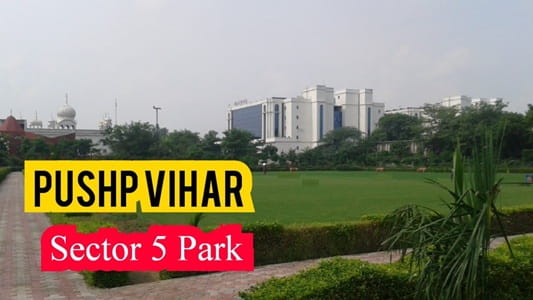
Internal to the locality, the well-planned road layout maintains wide streets and sector-level parks that support morning walks and children’s outdoor activity. The locality’s safety rating of 4.2 out of 5 reflects active policing — traffic cops are specifically mentioned as a visible presence that keeps road discipline and public safety at a higher standard than many South Delhi residential zones.
Air quality tracks South Delhi’s general pattern — better than industrial corridors, affected by winter inversions, meaningfully improved by the forest adjacency which provides natural particulate filtration. The MB Road and Outer Ring Road traffic generates the zone’s primary vehicular pollution exposure on boundary-facing properties; forest-facing blocks experience noticeably cleaner air during most of the year.
FAQs About Pushp Vihar Delhi
Q1. Which metro line serves Pushp Vihar?
A: Malviya Nagar metro station on the Yellow Line is approximately 2 km away. Chirag Delhi and Saket stations are additional Yellow Line options within accessible range. The Yellow Line provides direct access northward to AIIMS, INA, Bhikaji Cama Place, Connaught Place, and beyond, and southward to Chhattarpur, Sultanpur, and Huda City Centre in Gurugram.
Q2. How close is Select Citywalk to Pushp Vihar?
A: Select Citywalk Mall is effectively adjacent through the Saket District Centre boundary — accessible by a short walk, auto, or via the Yellow Line metro to Saket station. It is the locality’s primary retail, entertainment, and dining destination and is a significant locational benefit for daily urban life.
Q3. Why is Pushp Vihar considered good value in South Delhi?
A: Property prices are below Saket and Hauz Khas while offering equivalent Yellow Line metro access, Sanjay Van and Hauz Rani Forest adjacency, Select Citywalk within reach, Qutub Minar at 4.3 km, Pushpawati Singhania Hospital within the locality, and IGI Airport at 14 to 17 km. The gap between Pushp Vihar’s price and its locational peers is the core value argument.
Q4. Which hospitals are in Pushp Vihar?
A: Pushpawati Singhania Hospital and Research Institute — a 250-bed multi-specialty hospital on Press Enclave Road — is within the locality. Mehta Hospital and Sawan Neelu Angel’s Multi-Specialty Hospital serve secondary and general care needs. For tertiary care, AIIMS is approximately 25 minutes by Yellow Line metro northward, and Max Saket is within short metro-and-walk distance.
Q5. What is the significance of Sanjay Van for Pushp Vihar residents?
A: Sanjay Van is a 773-acre preserved ridge forest within walking or short-drive distance from Pushp Vihar. It provides forest-quality walking trails, resident wildlife (nilgai, peacocks, reptiles), a measurably cooler microclimate, and natural air quality improvement from particulate filtration. For a residential zone within 14 km of IGI Airport and 9 km of Nehru Place, this level of forest access is extraordinary by Indian urban standards.