
Push open both wardrobe doors in a compact Indian bedroom, and if your bed sits anywhere close by, you’ll genuinely discover you can’t actually open them fully without shifting furniture around first. This exact frustration plays out daily in countless Indian homes, where bedroom sizes have genuinely shrunk in newer apartments while wardrobe storage needs have stayed exactly the same, or grown, given how much a typical Indian household stores, sarees, kurtas, folded clothes, and countless accessories.
Here’s why this decision genuinely deserves more thought than picking whichever looks nicer in a showroom catalogue: sliding and hinged wardrobes aren’t simply different price points for identical storage, they genuinely demand different amounts of floor clearance, offer different accessibility, and carry meaningfully different long-term maintenance requirements. Understanding exactly how much space your specific bedroom genuinely has, and how you actually use your wardrobe daily, determines which option genuinely serves you better.
Why Floor Clearance Genuinely Determines Your Real Choice
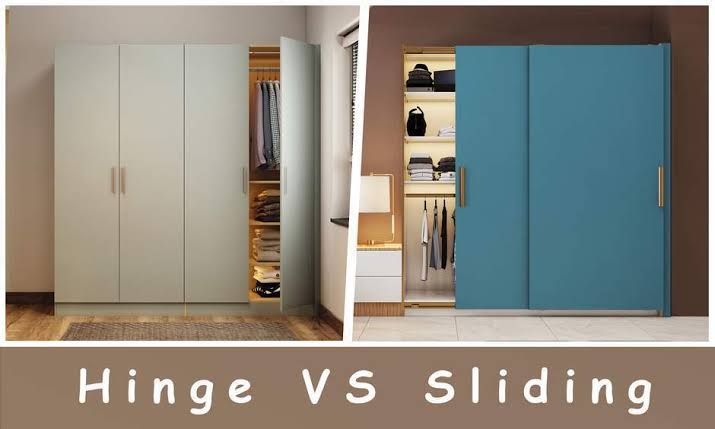
This is genuinely the single most important practical factor, and it should come before any aesthetic preference. Hinged wardrobes need 600 to 700 millimetres of clearance in front, roughly 2 to 2.5 feet, for full door access, space that becomes genuinely significant in a compact 10×10 bedroom where every square foot matters. Sliding wardrobes need essentially zero clearance in front, since their doors move horizontally along tracks rather than swinging outward into your room.
This means if your bed sits close to your wardrobe, a genuinely common layout constraint in smaller Indian bedrooms, hinged doors may not open fully without bumping into furniture, a real daily annoyance rather than a minor inconvenience. For bedrooms under roughly 150 square feet, this clearance requirement alone often settles the decision firmly in favour of sliding wardrobes regardless of any other consideration.
Understanding the Genuine Cost Difference
This gap is genuinely consistent across multiple sources and worth budgeting around honestly. Hinged wardrobes are generally 20 to 40% less expensive than sliding wardrobes of the same size and material, primarily because sliding systems require quality tracks, rollers, and aluminium profiles that hinged doors simply don’t need. For an 8×7 foot wardrobe, this translates to hinged running roughly ₹20,000 to ₹50,000, while sliding typically costs ₹25,000 to ₹70,000 for comparable quality.
It’s genuinely worth knowing that cheap sliding hardware creates real problems down the line, budget tracks lead to jamming and noise within just 3 to 4 years, while quality aluminium channel tracks with soft-close mechanisms from established brands add ₹8,000 to ₹20,000 to your cost but genuinely prevent this frustrating deterioration. If you’re choosing sliding specifically for its space advantage, investing in proper hardware genuinely matters more than it might for a hinged wardrobe’s simpler mechanism.
Why Hinged Wardrobes Genuinely Win on Accessibility
This is worth being fair about, since sliding doesn’t win every measure. Hinged wardrobes offer full-view access, opening completely to let you see and reach your entire wardrobe contents simultaneously, genuinely making it simple to grab outfits quickly, especially useful during a rushed morning when you need to see everything at once. Sliding wardrobes, by contrast, only expose one section at a time as you slide the door across, meaning you genuinely can’t view your entire storage simultaneously the way a fully-opened hinged door allows.
For households prioritising quick, full visibility over space efficiency, particularly in larger bedrooms where clearance genuinely isn’t a constraint, this accessibility advantage genuinely makes hinged wardrobes the more practical everyday choice despite their space requirements.
Why Maintenance Demands Genuinely Differ Considerably
This matters particularly for Indian conditions, where dust genuinely accumulates faster than in many other climates. Sliding tracks collect dust, especially in Indian cities, requiring periodic cleaning to prevent dirt from obstructing smooth movement over time. Hinged hinges are considerably simpler to clean and genuinely cheaper to replace when needed, a basic hinge costs a fraction of an entire track system, making repairs genuinely more affordable and straightforward for hinged wardrobes compared to fixing a jammed or worn sliding mechanism.
This maintenance gap genuinely matters for anyone who doesn’t want to add another periodic cleaning task to their household routine, though it’s worth noting that quality track systems genuinely minimise this issue considerably compared to budget hardware that accumulates problems faster.
Why Design Aesthetics Genuinely Serve Different Purposes
Sliding wardrobes deliver a genuinely clean, flat wall effect with floor-to-ceiling panels, suiting modern, minimalist bedroom aesthetics particularly well, and they’re genuinely popular in contemporary high-rise apartments precisely for this sleek, contemporary look. Hinged wardrobes offer considerably more design customisation, particularly for traditional or transitional interior styles, where classic panelled doors genuinely complement the room’s overall character better than a modern sliding system would.
This aesthetic distinction genuinely matters for matching your wardrobe to your home’s broader design language, a traditional wooden-hinged wardrobe genuinely feels out of place in an ultra-modern apartment, just as a sleek glass sliding system might genuinely clash with a more classic, heritage-style bedroom.
Making the Genuinely Right Choice for Your Specific Bedroom
If your bedroom measures under roughly 150 square feet, or your wardrobe placement genuinely doesn’t allow full hinged door swing without obstruction, sliding wardrobes genuinely justify their higher cost through the space efficiency they provide. If you’re working with a larger bedroom, prioritise budget and full accessibility, or want a more traditional aesthetic, hinged wardrobes genuinely remain the practical, economical default that most Indian households have relied on for good reason.
Frequently Asked Questions
Q1. Is a sliding wardrobe genuinely worth the extra cost if my bedroom has plenty of space?
Not necessarily, if your bedroom comfortably accommodates the 600 to 700mm clearance hinged doors need without any furniture obstruction, hinged wardrobes offer better accessibility and lower cost, making sliding’s space-saving advantage genuinely less relevant when space isn’t actually constrained.
Q2. Do sliding wardrobe tracks genuinely require much maintenance in Indian homes?
Yes, genuinely, sliding tracks collect dust more readily than hinges, especially in Indian cities, requiring periodic cleaning to prevent obstruction, though investing in quality track hardware from established brands genuinely reduces this maintenance burden compared to budget systems that wear out faster.
Q3. Can I genuinely convert my existing hinged wardrobe to a sliding system later?
Yes, this is genuinely possible if your wardrobe carcass is sturdy and properly aligned, typically costing ₹15,000 to ₹40,000 depending on size, covering new shutters, aluminium frame, sliding channels, hardware, and installation.
Q4. Which wardrobe type genuinely suits a household that needs to grab clothes quickly every morning?
Hinged wardrobes genuinely work better for this specific need, since they offer full-view access to your entire wardrobe contents simultaneously, while sliding doors only expose one section at a time, making quick, complete visibility considerably harder during a rushed morning routine.