
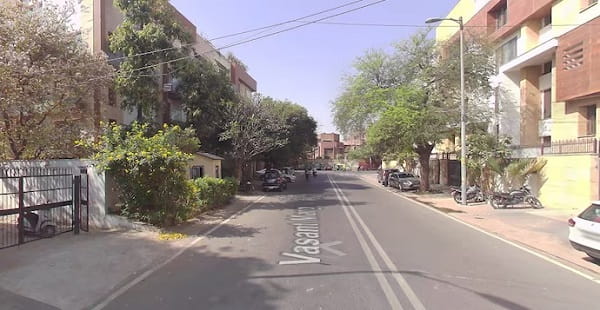
Vasant Vihar Delhi belongs to a very short list of Delhi addresses where the reputation has never needed refreshing. Developed in the 1960s initially for retired Government of India officers, this South Delhi locality carries PIN code 110057 and a resident profile that today includes senior bureaucrats, corporate executives, diplomatic staff, and some of India’s better-known business families. Chanakyapuri’s embassy belt sits immediately adjacent, and that proximity is felt everywhere — in the security, the road maintenance, the tree cover, and the particular quiet that distinguishes Vasant Vihar’s internal lanes from the rest of urban Delhi.
Its layout was deliberately organised around four main roads — Munirka Marg, Vasant Marg, Poorvi Marg, and Paschimi Marg — creating a structured grid that has held its form over six decades. Inside that grid sit bungalows, plotted homes, independent builder floors, and a handful of luxury apartment blocks. Hero MotoCorp’s corporate headquarters occupies the Basant Lok Community Centre address, giving the locality an unexpected corporate anchor amid its predominantly residential character.
Vasant Vihar Delhi Quick Overview
| Feature | Details |
| Location | South West Delhi |
| PIN Code | 110057 |
| Metro Station | Vasant Vihar – Magenta Line (operational) |
| Key Roads | Outer Ring Road, NH 48, Rao Tularam Marg |
| Nearest Railway Station | Safdarjung – approx. 4 km via Vasant Marg |
| Airport Distance | IGI Airport – approx. 20–25 minutes |
| Avg. Sale Price | ₹40,950 per sq ft (avg.) |
| Monthly Rental Range | ₹35,000 – ₹1,30,000 (1–3 BHK) |
| Key Landmark | Basant Lok Market, PVR Priya, Hero MotoCorp HQ |
| Nearby Areas | Anand Niketan, Shanti Niketan, Munirka, R.K. Puram, Hauz Khas |
Vasant Vihar Connectivity – Metro, Roads, and Airport Access
The Vasant Vihar metro station on the Magenta Line is the locality’s primary transit anchor, connecting residents directly into a corridor that runs from Botanical Garden in Noida through Kalkaji Mandir, Janakpuri West, and toward the expanding Phase 4 network. Munirka metro station provides an additional nearby option on the same line for those on the colony’s eastern edge.
Despite metro access, many Vasant Vihar residents continue to prefer private vehicles for daily movement — a pattern that reflects both the car ownership density of the locality’s demographic and the fact that most destinations the resident profile frequents are themselves not particularly metro-convenient. The surrounding road network compensates: Outer Ring Road gives fast access to Gurgaon and the airport corridor via NH 48, while Vasant Marg connects toward Safdarjung Railway Station approximately 4 km away. Rao Tularam Marg links the locality to R.K. Puram and Ring Road, though this road sees heavy congestion during peak hours.
IGI Airport is approximately 20 to 25 minutes by road under normal traffic conditions — one of the shortest airport commute times available from any established South Delhi residential address.
Vasant Vihar Landmarks and Key Facilities
Basant Lok Market — also known as Priya Market — is the neighbourhood’s social and commercial heart. PVR Priya, one of Delhi’s older and more beloved cinemas, anchors the entertainment end of this market strip. Restaurants, cafes, a pharmacy cluster, banks, and boutique retailers fill the rest of the Basant Lok stretch. It is the kind of market that serves both daily needs and Saturday evening outings without requiring anyone to leave the immediate neighbourhood. The Chanakya mall and DLF Emporio are within a short drive for luxury retail and fine dining.
The diplomatic dimension of Vasant Vihar is not incidental to daily life here. Embassy residences from multiple countries are woven into the colony’s residential fabric, which drives the security infrastructure — regular police patrolling, boom barriers in certain sectors, and a general level of institutional attention to the area’s maintenance. For residents who work at or with embassies in the adjacent Chanakyapuri belt, the commute involves a five-minute drive at most.
The Uttara Swami Malai Temple, approximately 3 km from the colony, is a significant South Indian religious site in Delhi frequented by residents and visitors from across the city. The Aravalli Biodiversity Park, accessible from the broader area, provides a green lung of genuine ecological value.
JNU and IIT Delhi are both within 10 to 15 minutes by road, making Vasant Vihar a practical residential option for faculty and senior researchers at both institutions.
Schools, Colleges, and Healthcare in Vasant Vihar
The school presence within Vasant Vihar itself is high-quality and recognisable. Sriram School, Modern School, Tagore International School, Delhi Public School (Junior Branch), and Holy Child Auxilium School serve the locality’s resident families. These are among the more sought-after school addresses in South Delhi, and their presence within the colony is a significant driver of the sustained family-buyer demand.
For higher education, JNU, IIT Delhi, and Delhi University’s South Campus are all within 10 to 15 km — a cluster of academic institutions rarely matched in proximity for any single residential address in Delhi.
Healthcare is well covered regionally. VMMC and Safdarjung Hospital — a major government facility — is accessible via Vasant Marg. Max Multi Speciality Centre, Fortis Flt Lt Rajan Dhall Hospital, and Research and Referral Hospital within the Army Hospital complex serve specialist and emergency needs. Prem Chikitsa Kendra handles primary healthcare within the immediate area. ILBS (Institute of Liver and Biliary Sciences) is within 7 to 8 km for hepatology and gastroenterology.
Vasant Vihar Real Estate – Property Rates and Investment Outlook
Vasant Vihar operates in a price bracket entirely separate from most of Delhi’s residential market. The average sale price currently sits at approximately ₹40,950 per sq ft, with individual bungalows and independent houses on 250+ sq yard plots running into multiple crores. Monthly rentals range from ₹35,000 for compact 1 BHK configurations to ₹1,30,000 and beyond for full-floor independent houses with parking.
The buyer profile here is entirely distinct from appreciation-hunting investors. Vasant Vihar is a prestige-driven, stability-oriented market where transactions happen slowly and at prices that reflect location permanence rather than cyclical sentiment. The limited supply of new housing — the area is built out and there are no large parcels available for new development — keeps values structurally protected. Rental demand from diplomatic staff, senior executives, and expat professionals maintains consistent occupancy at the upper end of the market.
The primary constraint for new buyers is simply entry price. A builder floor transaction in a reasonable block on a decent road rarely happens below ₹4 to 5 crore. For the buyers that number qualifies, there is very little in Delhi that competes on the combination of address prestige, airport proximity, institutional neighbourhood quality, and school access.
Vasant Vihar Environment – Green Spaces, Air Quality, and Neighbourhood Character
Tree-lined streets are not an aspiration in Vasant Vihar — they are the baseline. Poorvi Marg and Paschimi Marg in particular carry mature tree cover that creates a genuine canopy effect, with air quality in the interior of the colony measurably better than what the Delhi average would suggest. Residents describe walking and jogging along these roads as experiences that feel disconnected from the capital’s standard urban reality. That is an accurate description, not marketing copy.
The Aravalli Biodiversity Park, functioning as an ecological reserve within urban Delhi, is accessible from the locality’s southern edge and adds genuine environmental value. Multiple pocket parks and block-level green spaces across the colony maintain the low-density, garden-suburb quality that has characterised Vasant Vihar since its earliest planning.
The air quality and noise picture is not entirely perfect — Rao Tularam Marg congestion brings traffic pollution to the western edge, and the broader Delhi-wide particulate picture during winter inversions affects every neighbourhood including premium ones. Open garbage dumping in certain service lanes has been raised by residents as a maintenance concern. These are the friction points in an otherwise well-maintained urban environment, and they are genuinely minor relative to what the same infrastructure gaps look like in higher-density Delhi localities.
FAQs About Vasant Vihar Delhi
Q: Which metro line serves Vasant Vihar?
A: The Vasant Vihar metro station is on the Magenta Line, connecting to Botanical Garden (Noida direction) and toward Janakpuri West and the ongoing Phase 4 extension. Munirka station on the same line serves the colony’s eastern edge.
Q: What are the current property rates in Vasant Vihar?
A: The average sale price sits at approximately ₹40,950 per sq ft, placing it among South Delhi’s most expensive residential addresses. Monthly rentals range from ₹35,000 for compact units to ₹1,30,000 and above for larger independent floors.
Q: Why is Vasant Vihar associated with embassies?
A: Chanakyapuri — Delhi’s designated diplomatic enclave — is immediately adjacent to Vasant Vihar. Many embassy residences, official guest houses, and diplomatic staff accommodations are located within or immediately bordering the colony, driving the area’s distinctive security infrastructure and resident profile.
Q: How far is IGI Airport from Vasant Vihar?
A: Approximately 20 to 25 minutes by road via NH 48 or Outer Ring Road under normal traffic. The airport’s proximity is one of Vasant Vihar’s most consistently cited residential advantages, particularly for residents who travel frequently.
Q: Which schools are located in Vasant Vihar?
A: Sriram School, Modern School, Tagore International School, Delhi Public School Junior Branch, and Holy Child Auxilium School are among the reputed institutions within or immediately adjacent to the colony. This school density is a primary driver of family demand for the locality.
 Saurav Mehra