
Standing at a computer hardware shop in Delhi’s Nehru Place, comparing two seemingly identical RAM sticks, one genuinely costs considerably more despite looking almost indistinguishable from the other. This exact confusion genuinely trips up countless PC builders across India, DDR4 and DDR5 look nearly the same on the shelf, yet they’re genuinely built on different technology, incompatible with each other’s motherboards, and priced meaningfully differently, making this decision genuinely worth understanding properly before you commit to either platform.
Here’s why this comparison genuinely deserves careful thought rather than automatically chasing the newer technology: DDR5 genuinely delivers real performance improvements, but the actual, practical benefit you’ll notice depends enormously on what you’re actually doing with your PC, gaming, content creation, or simple everyday browsing all benefit from this upgrade quite differently. Understanding exactly where DDR5’s premium genuinely pays off, and where DDR4 remains perfectly sensible, helps you avoid overspending on speed you’ll genuinely never notice.
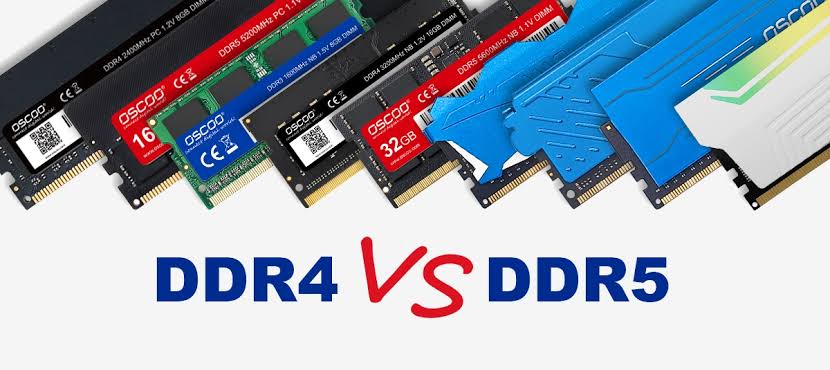
Why DDR5 Genuinely Delivers Meaningful Technical Improvements
This deserves stating clearly upfront, since DDR5 isn’t purely marketing hype. DDR5 offers significantly higher bandwidth, up to 8,400 MHz compared to DDR4’s 3,200 MHz ceiling, alongside improved power efficiency running at just 1.1V versus DDR4’s 1.2V, and genuine architectural improvements like increased parallelism through two channels per module. A typical DDR5-5600 kit genuinely offers around 50% more bandwidth than an equivalent DDR4-3600 kit, translating into genuinely faster data transfers for workloads that actually demand this throughput.
This represents genuine technical progress rather than an incremental refresh, though it’s worth understanding honestly that these improvements matter considerably more for specific use cases than for typical everyday computing, exactly why the real-world decision genuinely depends on your particular workload rather than DDR5 automatically being the universally correct choice.
Why the Genuine Gaming Benefit Genuinely Depends on Your Resolution and CPU
This is genuinely the most important practical consideration for anyone building a gaming PC. At 1440p and 4K resolutions, the graphics card almost always becomes the bottleneck, meaning switching from DDR4 to DDR5 might net you just 2 to 5% improvement in most titles, a difference genuinely too small to notice during actual gameplay. In CPU-bound scenarios specifically, competitive esports titles at 1080p with lower settings, or simulation-heavy games like Civilization, DDR5 can genuinely show 10 to 15% improvements, a more meaningful gap worth considering if this describes your specific gaming habits.
This means unless you’re genuinely chasing every last frame at 1080p in CPU-limited games, DDR4 remains genuinely perfectly fine for gaming in 2026, and the money saved would genuinely deliver more noticeable improvement invested into a stronger graphics card instead.
Understanding the Genuine Cost Comparison in India
This gap is genuinely significant and worth budgeting around honestly. A reliable 16GB DDR4-3200MHz kit from established brands like Corsair, G.Skill, or Adata typically costs ₹3,500 to ₹4,500 in India, while a comparable 16GB DDR5-5200MHz or 5600MHz kit runs ₹5,500 to ₹7,000. This gap widens for larger configurations too, 32GB DDR4 costs ₹6,500 to ₹8,500 compared to DDR5’s ₹10,000 to ₹13,000, and the total platform cost difference, factoring in the corresponding motherboard price gap, typically adds ₹4,000 to ₹7,000 to your entire build.
For PC builds under ₹70,000 total specifically, DDR4 genuinely represents the overwhelmingly smarter financial choice, since the ₹5,000 to ₹7,000 saved on RAM and motherboard could genuinely upgrade your graphics card from a 6GB to an 8GB card, a change that transforms your actual gaming performance far more meaningfully than the RAM upgrade would.
Why Content Creators and Professionals Genuinely Benefit More From DDR5
It’s genuinely worth being fair to DDR5 here, since certain workloads clearly justify its premium. Video editing, 3D rendering, and AI-related workloads genuinely love memory bandwidth, and DDR5 can cut render times by 15 to 30% in applications like DaVinci Resolve, Blender, and Premiere Pro compared to equivalent DDR4 configurations. If you genuinely earn income using your PC for this kind of demanding creative or technical work, this rendering time improvement genuinely justifies DDR5’s extra cost considerably more easily than a purely gaming-focused build would.
Why Compatibility Genuinely Matters More Than People Realise
This is a genuinely critical practical point worth understanding before purchasing anything. DDR4 and DDR5 are not compatible with each other whatsoever, meaning your motherboard genuinely must be built specifically for one or the other, you cannot simply plug DDR5 into a DDR4 slot or vice versa. If you already own a functioning DDR4 system, sticking with DDR4 genuinely remains the smart financial move rather than replacing your entire motherboard and CPU just to access DDR5’s benefits, since that platform overhaul cost genuinely dwarfs the memory price difference alone.
Why DDR4 Prices Are Genuinely Rising Despite Being Older Technology
This is a genuinely counterintuitive trend worth knowing about. As DDR5 production scales up, manufacturers are winding down DDR4 production lines, and with less DDR4 being manufactured while continued demand persists from the massive installed base of DDR4 systems still actively in use, supply tightens and prices genuinely rise over time. This trend is expected to continue, meaning fresh DDR4 purchases are becoming a progressively poorer value proposition specifically for brand-new builds, even though DDR4 remains genuinely sensible for upgrading an already-existing DDR4 system.
Making the Genuinely Right Choice for Your Specific Build
If you’re building a brand-new PC in 2026 with a modern CPU platform, DDR5 is genuinely the recommended path for future-proofing and platform longevity, since newer Intel and AMD processors are increasingly designed primarily around DDR5. If you’re upgrading an existing DDR4 system or building on a genuinely tight budget where every rupee matters, DDR4 still delivers excellent, perfectly adequate performance at meaningfully lower cost, particularly for gaming-focused builds where the graphics card matters considerably more than RAM speed.
Frequently Asked Questions
Q1. Will upgrading from DDR4 to DDR5 genuinely improve my gaming performance noticeably?
Only in specific scenarios, at 1440p or 4K resolution, the difference is typically just 2 to 5%, barely noticeable, though in CPU-bound situations like competitive esports at 1080p, you might genuinely see a more meaningful 10 to 15% improvement.
Q2. Can I genuinely install DDR5 RAM into my existing DDR4 motherboard to save money?
No, genuinely not possible, DDR4 and DDR5 are entirely incompatible with each other, requiring a specifically designed motherboard for whichever standard you choose, meaning switching requires replacing your entire platform, not just the RAM sticks themselves.
Q3. Why does DDR4 genuinely cost more now than it did a couple of years ago, despite being older technology?
As manufacturers wind down DDR4 production to focus on DDR5, supply is genuinely tightening while demand from existing DDR4 systems continues, pushing prices upward despite DDR4 being the older, theoretically less advanced technology.
Q4. Is DDR5 genuinely worth the extra cost for someone who does video editing alongside gaming?
Yes, genuinely, if you regularly do memory-intensive creative work like video editing or 3D rendering, DDR5’s bandwidth advantage can cut render times by 15 to 30%, making its premium considerably easier to justify than for purely gaming-focused use.